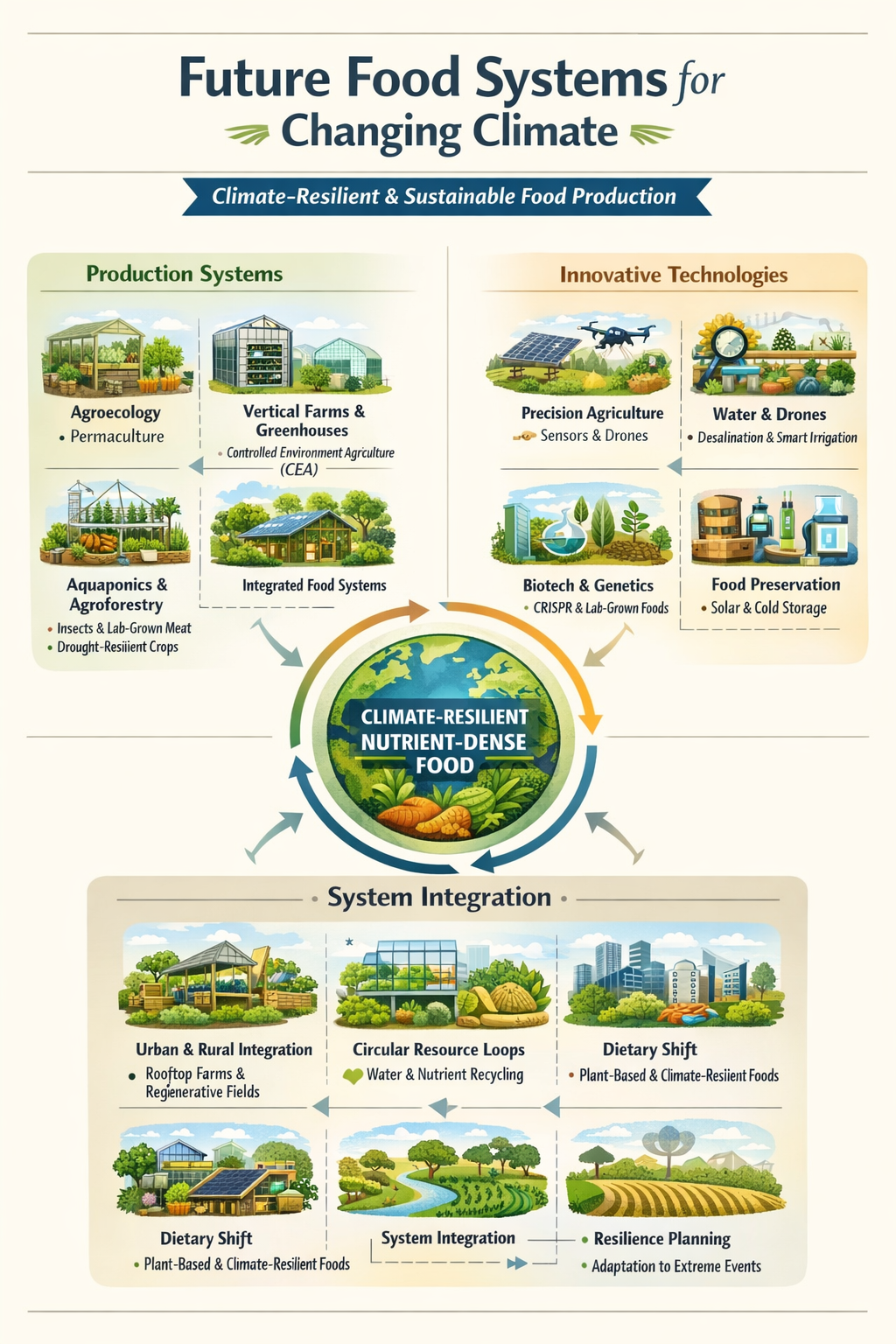
[Central Goal]
Climate-Resilient, Sustainable, Nutrient-Dense Food Production
1. Production Systems (Where Food is Grown)
A. Regenerative & Outdoor Farming
-
Methods: Agroecology, regenerative cropping, permaculture, wicking beds.
-
Benefits: Soil carbon capture, biodiversity, water resilience.
-
Applications: Rural farms, urban community gardens.
B. Controlled Environment Agriculture (CEA)
-
Methods: Greenhouses, vertical farms, plant factories, hydroponics.
-
Benefits: Year-round production, climate-proofed, reduced land footprint.
-
Applications: Urban rooftops, courtyards, peri-urban farms.
C. Integrated Systems
-
Examples: Aquaponics (fish + plants), agroforestry (trees + crops + livestock).
-
Benefits: Circular nutrient and water systems, multi-layered yields.
-
Applications: Urban vertical farms, small-scale rural farms.
D. Diversified & Alternative Food Production
-
Examples: Edible insects, lab-grown meat, pulses, heat/salt-tolerant crops.
-
Benefits: Lower resource use, climate adaptation, protein variety.
-
Applications: Urban & rural diets, food security strategies.
2. Supporting Technologies (How Food is Managed & Optimized)
A. Precision Agriculture
-
Sensors & IoT for soil moisture, nutrients, crop stress.
-
Drones & satellite imagery for monitoring and planning.
-
AI & predictive analytics for optimized planting and irrigation.
B. Water & Energy Efficiency
-
Smart drip/wicking irrigation, greywater reuse.
-
Desalination & atmospheric water capture.
-
Solar-powered greenhouses and pumps.
C. Biotechnology & Genetics
-
CRISPR-edited crops (heat, drought, pest-resistant).
-
Microbial fermentation for protein and food additives.
-
Lab-grown meat & alternative proteins.
D. Post-Harvest & Food Waste Solutions
-
Solar refrigeration & cold chain solutions.
-
Upcycling food by-products.
-
High-tech preservation (vacuum-sealing, modified atmosphere packaging).
E. Data-Driven Supply Chains
-
AI forecasting for climate-adaptive planting and demand.
-
Blockchain for transparency and traceability.
-
Localized supply chains to reduce food miles.
3. System Integration (Making It Work Together)
-
Urban & Rural Hybrid Model:
-
Urban: rooftop gardens, vertical farms, community micro-farms.
-
Rural: regenerative farms, diversified crops, agroforestry.
-
-
Circular Loops:
-
Nutrient cycling (compost, aquaponics).
-
Water recycling & efficient irrigation.
-
Energy from waste (biogas, solar).
-
-
Dietary & Cultural Shift:
-
Emphasize low-resource, high-nutrient crops.
-
Integrate traditional knowledge (like Noongar seasonal cycles) with modern tech.
-
-
Resilience Mindset:
-
Systems designed for extreme events: heatwaves, floods, supply disruptions.
-
Multi-layered approach: outdoor + indoor + urban micro-production.
-